Showing posts with label Rachel's Blog. Show all posts

Thursday, November 20, 2014

Why Father’s Rights Confuse and Irritate Me

Father's Rights ad, found on this site here.  I understand the viewpoint, however I can't help but be unsettled by this image.  Just because she's your daughter, does that not make her the mother's daughter too?
            In our most recent class on Tuesday, we spent time discussing Susan Bordo’s book titled Unbearable Weight: Feminism, Western Culture, and the Body.  Specifically, the chapter we focused on was called “Are Mothers Persons?  Reproductive Rights and the Politics of Subject-ivity”.  And within this chapter, one of the subjects brought up was the movement for father’s rights.  The particular subject and movement of Father’s Rights really stood out to me, mainly because I have never heard of it before encountering it in this reading. 
            The movement for father’s rights was essentially born from men’s desire to control women and their potential offspring.  Also, Bordo presents additional reasoning for the pushing of father’s rights: “One reason why the movement for father’s rights has grown so rapidly is the culturally powerful rhetoric of ‘equality’ with which the movement has trumpeted its cause,” (page 89).  However, Bordo goes on to elaborate that the notion of “equality” is more misconstrued and in reality becomes a mission to gain leverage over a mother’s rights.  Bordo states that “Any father seeking his ‘rights’ in such a case is claiming that his desires should not merely be equal but supersede those of the mother.  That is, what is being sought in father’s-rights cases is not equality for fathers but the privileging of parental interests,” (page 89).  When explained that way, I was appalled that fathers would try to assert their desires over those of mothers, who are the ones physically carrying the child.  Mothers are the ones who carry most of the weight in the baby-making process, and that is one reason why I believe if anything the mothers should have a higher control over their own bodies, not the fathers. 
            Many men also try to argue father’s rights on a belief born from our Western culture that fathers are the “true parents” instead of just one half of a child.  This belief originates from many different sources, some from Greek mythology to the Genesis story to Aristotle’s teachings.  These beliefs additionally contribute to the “mothers are only fetal incubators” idea, which I find to be sick and disgusting, because it is wrong to depersonalize women/mothers into baby-creating machines. 
            While writing this blog today, I keep coming back to one particular quote that we discussed in class regarding father’s rights.  This quote is from Erin Conn, a man suing his wife and taking a strong father’s rights position.  To defend his case, he argues that the “reproductive system” set in place is unfair because he himself cannot carry the fetus, and because he is half of that child he should have a say in whether or not it was aborted.  He makes a very possessive claim over the unborn child, claiming that he is part of this child just as much as the child is a part of him.  Following this claim, he asks: “She wants control of her body.  But what about me?  Am I not allowed to have control of my body?” (page 92).  This quote has been stuck in my mind, because quite frankly I find it completely absurd and outrageous.  This man is attempting to lay claim over a partially-developed fetus that only has half of his genetic material and is being gestated inside the body of another human being.  He seems to be forgetting that half of that fetus is also his wife’s, and that it is his wife that is physically pregnant and not him.  To me, those two factors alone completely outweigh his arguments.  Thankfully, most court cases align more with my thoughts, as mentioned by Bordo the Planned Parenthood of Central Missouri v. Danforth case where the Supreme Court ruled that “…since ‘it is the woman who physically bears the child and who is the more directly and immediately affected by the pregnancy … the balance weighs in her favor.’,” (page 90). 
            I guess what mainly gets on my nerves about the father’s rights movement is how it tries to take away power/rights from women/mothers, who already struggle as is to get and maintain various reproductive and medical rights.  Men have a lot of privilege and rights in our country already, and I feel that matters of pregnancy and abortion are not places that men should be sticking their noses into.  Pregnancy happens to women’s bodies, and I believe it should be left up to them to decide what they do with their bodies.  On a final note, I was browsing Upworthy for any parent-topic articles and came across this comic created by a feminist dad.  What’s really nice about this comic is that the father is realizing that he should not be controlling what his daughter will or won’t want.  It may not be related directly to father’s rights or women’s reproductive rights, but it is on the right track for allowing women to make decisions for themselves. 

Tuesday, September 23, 2014

Linking Gender Defenders, Transgenders, and Bisexuals (with some cool art/comics)

I felt this was appropriate, in the sense that if Gender Defenders would target trans people, they would be the cause of many of the things this picture illustrates. Drawn by Elias Ericson.

            From our past few class sessions, our class has focused on various readings that pertain to transgender people and how society handles the concept of being transgender.  One concept that stuck out to me most was in Kate Bornstein’s book Gender Outlaw, which was the concept of those who use strict ideas of gender to terrorize those who fall outside of our society’s “gender norms” (male and female).  These “gender terrorists” are referred to by Bornstein as “Gender Defenders”, and both Bornstein and I both agree that they do more harm than good for our society as a whole.  

            Before diving into why Gender Defenders are so harmful to our society, I want to look back at what Bornstein defined as a Gender Defender.  Before giving this group of people their designated name, Bornstein calls Gender Defenders “gender terrorists”.  She states that “Gender terrorists are those who bang their heads against a gender system that is real and natural; and who then use gender to terrorize the rest of us,” (page 71-72).  From what we have discussed in our previous classes, as well as what a majority of open-minded individuals can understand, we are aware that there is more to gender than just the strict male/female orientation that our society impresses on us to follow.  Therefore I see there is no surprise that there are these Gender Defenders; those who go through life unwilling to accept the possibility of a man deciding he would rather present himself as a woman, and vice versa, and all in between.  However, just because I understand why there are Gender Defenders and what has influenced their thought processes in our society, doesn't mean I believe their behaviors are justified.  

            I believe that these Gender Defenders are very harmful to our society for a multitude of reasons.  Firstly, these individuals are ignoring and suppressing a portion of our population that has the same basic rights that we all do.  By ignoring any transgendered individuals and refusing to accept that there is more to gender and sexuality than the gender binary, Gender Defenders are shutting down crucial conversation that needs to happen everywhere about any and all trans* issues.  Furthermore, I got to thinking about how some of these individuals who disregard transgendered individuals may be likely to disregard the rest of the LGBTQ+ community, which brings up a completely new social aspect to the situation at hand regarding the general scope of gender and sexual identity.  Those who stick to the gender binary are also likely to have a hard time understanding anything besides heterosexuality, which further creates a divide and even hostility between aggressors and those who fall anywhere else on the sexuality spectrum besides identifying as straight.

    A comic showing how being different
 from societal norms can isolate someone. Drawn by Emiliu.                             

            What’s a real shame is that when members of the LGBTQ+ community have preferences and different tolerances for members of certain sexualities or gender identities.  Two specific instances come to mind; the first being Bornstein’s example of lesbian separatists refusing to acknowledge transgendered women as women in their “women-only” spaces, and the second being the ongoing misinterpretation and blatant disregard of bisexuality by straight and gay members of society.      

            Regarding the first example, in Bornstein’s book she mentions that “women inhabit ‘women only’ spaces to heal from the oppression of their number by the larger culture, by men in particular, and because they don’t see us as women, we’re perceived as the other side of the binary: men,” (page 82).  Even though these are lesbians turning away trans women, they can be seen as Gender Defenders as they are choosing to not acknowledge these men who have crossed over and identify as women.  They (the lesbians) are defending the idea of adhering to the gender you are born with, and that is a problematic notion because there are many people in the world who identify differently, and additionally there is the whole topic of intersexuality that could be investigated to further the argument.  I feel that in order to clear up that tension, people in general should just focus on whatever gender someone is presenting themselves as at the particular present moment, and not focus on what they were born with or what they may have presented themselves as last week or even yesterday.  Some people change when they please, and therefore should feel comfortable doing so knowing that they will be held in the same regard as a man, woman, or other. 

            Referring back to my second example, I want to talk about the struggle that many bisexuals go through, because I feel that at times it emulates the difficulties that many Trans people might face.  I found this very interesting video on Upworthy about a bisexual woman, Scarlet Saint, who spends roughly ten minutes dispelling common bisexual myths by applying her knowledge on the subject and her personal experience as a bisexual individual herself.  What stuck out to me the most was her myth number 1, which was the notion that people believe that bisexuals are just indecisive and/or confused.  Scarlet goes on to talk about her experiences coming out as a bisexual to people, and how she is sometimes met with just blatant denial.  That, or people will try to apply their own impressions of her sexuality, trying to police her by implying that they know what she is and is not.  This sort of action of others trying to dictate what someone is or isn’t reminded me of how Gender Defenders use the gender binary as a sort of mold to try to push transgendered people into.  Not everyone fits into a neat and tidy gender binary, or even a sexual binary, and I believe that the more steps we take to educate people about the many different gender identities and sexual orientations in our world, the easier it will be for everyone to accept everyone for being themselves.  

Just a little sweet/funny comic about acceptance.  It would be nice if a trans* person was included, but I think the point is made all the same.  This comic was created by Cassian, and there are many more comics like this one (as well as the ones previously mentioned in this article) that can be found in this Buzzfeed article dealing with the struggles of being queer.)


Monday, September 8, 2014

Diverging from Questionable Corrective Surgeries

         
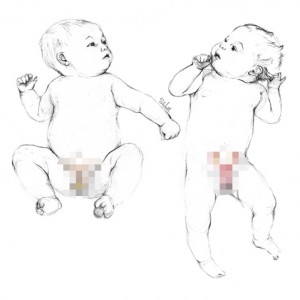
            For our readings over the past week, we have been primarily focusing on the topic of what it means to be male or female, and how intersexuality has developed socially and medically over the course of history.  While we had many interesting topics of discussion in class about said readings, I feel that there were two particular topics that stood out and interested me the most.  The first topicthat stood out to me was the discussion and reasoning for using the term “divergence of sex development”, and the second being the history and implications of doctors performing gender-corrective surgeries on intersex infants (children born with a varying degree of both male and female sexual organs).  Although both of these topics were covered in separate readings, they were both written by the same author Elizabeth Reis.  After finishing both readings and discussing them in class, I felt compelled to cross-examine them and relate the topics to one another. 
            The first topic comes from the reading called Impossible Hermaphrodites: Intersex in America; 1620-1960 by Elizabeth Reis explores how the views and definitions of hermaphroditism/intersexuality have changed over three centuries, in both the social world and the medical field.  In the beginning on page 411, Reis describes how medical practitioners did not believe in hermaphrodites in the 1600’s and insisted that any cases of ambiguous reproductive organs were cases of “mistaken genitalia” and not an actual medical occurrence.  She goes on to describe how that view changed, leading up to the most-current practice of doctors performing a “corrective” surgery to normalize infants’ genitalia.  Reis elaborates on these altering procedures on page 414, specifically about the work of psychologist John Money, who believed that very young infants could be molded physically and hormonally into a specific assigned gender and suffer no long-lasting negative effects.  Money was very wrong about these assumptions, as it turns out that many people who had these gender assignments as infants grew up either not feeling comfortable in their bodies, changing their genders, or feeling extremely ashamed by the forced secrecy and stigma about their different bodies.  The shame and secrecy that follows many intersex bodies is a large weight to bear, and it brings to mind the question asked by Alice Dreger, chair of the Board of Directors for the ISNA: “Why perform irreversible surgeries that risk sensation, fertility, continence, comfort, and life without a medical reason?” (page 414).  I believe the best-fitting answer to this question lies in the two-gender structure we have created in our society, and how in general we as humans are quick to regulate a sense of normalcy for our appearances.
            Going along with how our society perceives those with abnormal genitalia, I want to discuss the second topic I took interest in.  Divergence or Disorder? the politics of naming intersex is the other reading by Elizabeth Reis that we discussed in class.  In this reading, Reis focuses on the meanings and connotations assigned to different names given to the condition of intersexuality.  Intersex and Hermaphrodite, which have been terms used for longer periods of time, both contain a lot of negative connotations for the bearers of previously mentioned names, as well as the parents of said bearers.  For example, Reis writes that “Hermaphroditism, an older term that can still be found in many medical writings, is vague, demeaning, and sensationalistic, conjuring mythic images of monsters and freaks,” (page 535), which would be very offensive and upsetting for any intersex persons.  However, the label “intersex” itself can be considered harmful as well.  Reis explains that “…activists advocated intersex to describe discordance between the multiple components of sex anatomy, but that word alienated many parents of affected children, as it suggests a self-conscious alternative gender identity and sexuality,” (page 535).  She further explains this alienation by stating that “to them [the parents], intersex meant a third gender, something in-between male and female.  They wanted to see their newborn babies as girls or boys, not as intersex,” (page 537).  The most recently adopted name by the medical community is “disorders of sex development” (DSD), which many believe is a step in the right direction as it “deemphasizes the identity politics and sexual connotations associated with intersex and the degradation associated with hermaphrodite and instead draws attention to the underlying genetic or endocrine factors which cause prenatal sex development to take an unusual path,” (page 537-538). 
            While the phrase “disorders of sex development” may help doctors diagnose and treat patients, many intersex-identifying persons do not favor the term.  The main problem many intersexed people have with the phrase due to its use of the word “disorder”.  Due to the disability rights movement teaching people that being atypical shouldn’t be seen as disordered, many believe that disordered equals broken and in need of repair, consequently applying that definition they are not happy with the inference that intersex = seriously wrong and in need of help (page 538).  To remedy this, Elizabeth Reis offers up a slightly different phrase: “divergence of sex development”.  By swapping out “disorders” with “divergence”, Reis says that it “…would satisfy those who want to minimize the emphasis on genitals, gender identity, and sexual orientation that the intersex label may encourage. Using divergence, intersex people would not be labeled as being in a physical state absolutely in need of repair,” (page 541).  There are many other implications for using “divergence”, such as its usefulness in the political sphere as well as the medical community so that everyone can see the intersex condition in its full complexity.  I feel that “divergence of sex development” covers a wider scope of people and that it also allows for itself to be interpreted in different ways for different people.
            I feel like the new label “divergence of sex development” is important because of how it can be applied to those being born intersex today.  Elevating intersexuality above the idea of being a disorder can allow doctors and surgeons to not immediately jump to questionable corrective surgery just to fit a cultural norm.  I believe that this is important because it will save many intersex people from struggling to accept themselves in the bodies they were born in or dealing with the trauma the corrective surgeries can cause.

            What I thought was very interesting about these readings is how they changed and broadened my views on intersex-identifying people.  Although prior to the readings I was aware that intersexuality was a thing that existed, I never thought much of it.  These readings really opened my eyes to how long intersexuality has been a part of our social, political, and medical spheres, and just how much pressure and taboo are on intersex bodies from birth to death.  Coming away from these readings, I know I have learned a lot, however I also realize that I am just delving into the tip of the iceberg that is human gender and sexuality.  As a small closing example, I found an interesting blog article that touches on intersexuality and marriage equality, as well as how nature determines sex in different species.