Showing posts with label Deyalyn's Blog. Show all posts

Friday, December 5, 2014

My Biggest Problem With Gestational Surrogacy


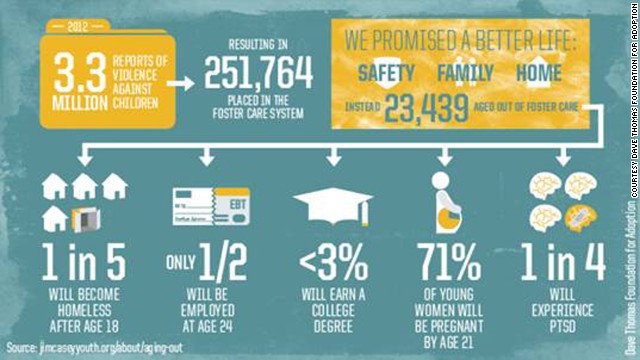
Out of all the troublesome issues France Winddance Twine raises in her book Outsourcing The Womb: Race, Class, and Gestational Surrogacy in a Global Market, the one that hurts me to the core is the fact that gestational surrogacy is replacing adoption as the go-to option for wealthy couples biologically unable to conceive children. According to AdoptUSkids there are currently 102,000 children in foster care waiting to be adopted, while 20,000 of them are aging out of the system every passing year. Over a hundred thousand children are living like nomads, moving from foster parent to foster parent, town to town, school to school every couple of months. Twenty thousand of them are 21 and considered adults, tossed out of the system without safety nets, never having known what it is like to have a permanent family who loves them and has the means to care for them.


It breaks my heart to realize that couples would rather rent the womb of an impoverished woman in India to incubate a semi-genetically related fetus than provide a home for a foster child who is already alive and in desperate need of their guidance. It says a lot about how people in our society envision the ideal family. What is it about the human condition in the United States that leads people to turn a blind eye to the growing number of children in foster homes even after realizing that having a child the natural way is impossible?

The same way race and class hierarchies underline the processes of gestational surrogacy, as Twine does an amazing job of explaining in her book, race and class hierarchies underline the decision making process of whether to foster, adopt or contract a surrogate. "In the United States assisted reproductive technologies are not accessible to the poor, working class, and many members of racial and ethnic minorities. Access to fertility treatments is available primarily to the wealthy, upper middle class, or those able and willing to borrow the money required. In other words, commercial surrogacy is limited to the economically privileged" (Twine pg. 8). The price for surrogacy is between $50,000- $100,000. In contrast, adopting a child from the foster care system costs between $0-$1000 according to adoptionhelp.org, which is far more doable for lower and middle class families. Furthermore, being a foster parent comes with monetary compensation, although it is never an exceptional sum. For this reason, most foster parents are usually people with modest economic backgrounds who often use fostering as a way to supplement their incomes.

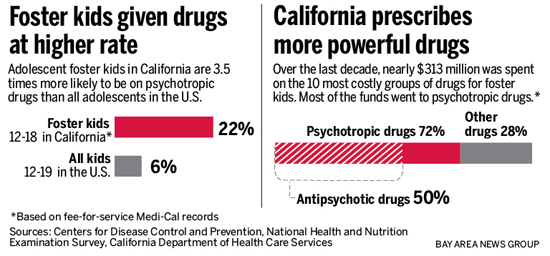
The desire to have genetically similar babies can not be separated from the desire to have white babies. There is clearly a monetary hierarchy in place in the business (gag) of having children. Twine's arguments goes even further with the addition of the race component when she states "the demand for white babies increased while the supply decreased"(pg. 4). According to the Child Welfare Information Gateway's Foster Care Statistics, more than half of the children entering foster care facilities are either African American, Hispanic/Latino, mixed race, or other. The way the demographics are distributed depend on what part of the country one is located. At the same time, most of these children were taken away from their parents due to neglect or unsafe conditions, so on top of the fact that they are minorities, there is a stigma surrounding the idea that these children are traumatized or disturbed and are likely to lash out against authority figures. This stigmatization is enforced through all facets of these children's lives as there are people benefitting from their demise. Pharmaceutical companies probably benefit the most, since Doctors tend to prescribe foster children with an alarming rate of psychiatric drugs.


The AdopUsKids website is quick to address these stereotypes by having videos of the children themselves talking about what it's like to be a foster child. I cried while watching the videos when it became apparent how aware these teenaged children are of how they are perceived by society. They are seen as "bad" children, when really the only thing that's bad is the world they did not choose to be born in. What's interesting about AdoptUSKids is how they have a catalogue of their children online, and you can search for a child by filtering results based on race, gender and age. I'll never understand the need to have a child of a specific race, but it could be linked to the desire of having a child that looks like the parent.

I'm not sure if it's socialization or human nature to want to leave behind a trace of your DNA after you're gone. It seems like a lot of the time, people are more concerned with that than leaving behind a good deed for mankind, or something that's truly meaningful. It hurts my heart to read about all these children growing up alone and without homes after seeing things no child should ever be around to see. It breaks my heart that wealthy couples, who have the resources to change these kids' lives are ignoring them, and instead feeding into the egoist capitalist beaurocratic franchise that is surrogacy.

Most people like to complain about their parents and are completely unaware of how blessed they are to have people who want them, love them and cherish them. I would not be the person I am today if it weren't for my mother's love and that makes me feel really deeply for children in the foster care system. I firmly believe that a parent's love is something everyone deserves to have. A lot of the issues Twine talks about in her book seem very far away from me. I don't know what I have in common with Indian women in caste systems. I can sympathize but I can't empathize. I do know that there are teenagers just like me without homes, whose futures are bleak because it is impossible to have a good education when you're switching schools every two months. I see myself in a lot of these children. I feel their pain. My heart goes out to them.

Thursday, November 20, 2014

Marxist Feminism: The Fall of Capitalist Oppression/ The Rise of Proletariat Personhood


"Modern bourgeois society with its relations of production, of exchange and of property,
a society that has conjured up such gigantic means of production and of exchange,
is like the sorcerer, who is no longer able to control the powers of the nether world whom
he has called up by his spells. For many a decade past the history of industry and commerce
is but the history of revolt of modern productive forces against modern conditions of production,
against the property relations that are the conditions for the existence of the bourgeoisie 
and of it rule. "(Marx's Communist Manifesto, p. 6)

Karl Marx's Communist Manifesto is a very important part of the building-blocks for many feminist theories. Marx was the first philosopher to assert that gender roles are not predetermined by nature, but rather by environmentally driven social forces. He argues that as capitalism progresses more rapidly, different needs arise for the human condition such as the distribution of labor, which changes societal implications for both genders. We saw this happen during the 1950's during WWII and then again in the 1970's and after the Vietnam war. During WWII many men were away at war for a long period of time, and women were needed in the workforce. After the Vietnam war, our depressed economy led to many mothers taking up jobs to support their families.

Marx's critique of capitalism has come with many modifications and critiques. Reading Marx during my Junior year in high school, I agreed with most of what he said, but severely questioned his prophesies regarding what capitalism would inevitably amount to. After all, Marx does not have a crystal ball that reads into the future of capitalism. After a few more years of higher education and a sharpened eye for injustice and oppression however, I see his prophesies becoming true all around me. Every year our  world seems a little different, every year the richer get richer and the poorer get poorer, every year cooperations get larger and family-owned businesses get smaller.


Every decade, society's expectations for women inflate and get more difficult to fulfill. Regardless of women's rights to vote and have a place in the workforce, these rights still did not grant women, especially pregnant women, subjectivity in the eye of the law. Yes a woman shall work, as long as it's a pink collar job (and now we're back to marx's division of labor). Yes a woman may vote, but they'll never be fit for presidency. Yes a woman is equal to men, except for when she's pregnant, in that case, she's not even an actual person.

In Susan Bordo's "Are Women Persons", she describes case after case of pregnant women being treated as "fetus incubators" in the eyes of the law and the medical world. They are denied their personhood and subjectivity because they are carrying a life. Bordo does not offer an explanation of why a fetus is seen as more of a person than the woman who is carrying it, heck, pro-lifers can't even explain that themselves, but I think Marx can be very helpful in giving us a backdrop on how the aims of capitalism are equal to that of the American dream, and how this leads to a disdain for "selfish" women who do not want children.

See, when pro-lifers say a fertilized egg has the potential for life, what they are actually saying (mostly unknowingly) is that a fertilized egg is a potential consumer, another little one to fit in the assembly line chain and carry his father's lineage. Another little one that parents need to buy diapers for, christmas gifts, a college education, an iPhone, etc.  We know this due to our country's long horrid history of eugenics and forced sterilization. If a family is well-off, that fetus rules over anyone who is opposed to letting the pregnancy go to term, usually a woman who was not planning for a baby in the near future. However, when a family is deemed poor or "un-fit to care" for a future child in any way, several states have gone through lengths to ensure that they will be incapable to bear children. They will not be good consumers, they are too poor to buy macbook pros and contribute to our capitalist economy, therefore they are unworthy. Their subjectivity vanished.

There is one thing in our society that is valued more than the personhood of women and the poor, and that one thing is money. The invent of capitalism has created a society that runs on a green piece of paper. Individual craft is gone, everything is mass produced for bigger profit. Workers are not people, they are commodities who serve in a business while receiving relatively little in return. Women are not people, they are commodities who serve the men in our society, forced to create for them that American dream. While the men work the assembly lines, the women are the fetus incubators, hatching out the working man's seeds, giving him something to work harder for. Trapping them both, so that a man must work with capitalism to feed his children, and a woman must work with capitalism to keep the home expensively beautiful and clean for the working man to come home to.


Capitalism, the American dream, the emphasis on family, and lack of abortion rights in the US are all highly intertwined. Capitalism feeds off of a family's needs to keep up with society's ideals. These ideals are upheld by the media portraying really expensive upper-middle class homes as the norms of society. The media tells us that babies are the epitome of purity and innocence and they must be protected above all cause. Capitalists want us to believe that the family and that white picket fence is the most important thing, that it'll bring true happiness because this is how they make their money. A decently well-off  white mother getting an abortion is unheard of, a waste, a selfish act, she's a witch. Her subjectivity is nulled in the eyes of profit-based bureaucracy. But mass sterilization of poor minority women is justifiable, subjectivity non-existent. This is not a coincidence. One can look at any evil done by the US government since its birth, and trace back every single one of those evils to the greedy aspirations of wealth and production.


Thursday, November 6, 2014

Femininity, Mo'ne Davis Style

Everyone misses being a kid. We smell a certain scent or hear a certain sound and we shudder with nostalgia; it feels good and bad all at once. We think of a distant time when we were fully unaware, of our surroundings, of each other, of our bodies. We did things without thinking of repercussions because those didn't exist yet. My mother always tells me this story of when I was 3 years old and she walked into the backyard of my grandmother's farmhouse in the Dominican Republic and found me cooped up on the grass with three massive Rottweiler hunting dogs, my hand inside one of their mouths. No concept of danger, no fear, no shame. There were no limits that I could conceive of. I wasn't molded yet.

Celia Bullwinkel took to film to explain the life of a female and the never ending plight against her own body. What struck me the hardest out of the progressing storyline of the short animation "sidewalk" is how she explains what happens to a girl around her preteen years. Around the 25 second mark of the video, her character walks past a billboard that reads "Big Girl" along with pictures of two girls who looked older and were dressed in the way we modernly picture teenage girls to dress. After walking past that image, she changes the way that she walks. She lifts up her chest, straightens her back, and sucks in her stomach. She looks a little older too, suggesting it's been a year or two.

This is something that many females can relate to. I began hesitating when I was 12. I realized that I was now not only a female, but also sexualized. I began to focus on being pretty, in everything that I did. I didn't take any more chances and fear took its roots. For the rest of my life up until this point, I've approached physical things with what Iris Young would call an "inhibited intentionality," a phrase derived from her piece titled "Throwing Like a Girl". That is the only thing that separates me or any other girl from being like Mo'ne Davis


There is nothing inhibited in the way Mo'ne plays, or the way she presents herself. She is not thinking about how to present herself, she's just doing what she loves, so clearly and naturally being who she is, being a human being. Young writes, "'To understand is to experience the harmony between what we aim at and what is given, between the intention and the performance...' Feminine motion often severs this mutually conditioning relation between aim and enactment. In those motions which when properly performed require the coordination and directedness of the whole body upon some definite end, women frequently move in a contradictory way"(146).  I don't buy the idea that her ability to do this is derived from her race, I believe our perception of her is derived from our own ideas about her race. 

Mo'ne is not the first girl to ignore the "must be feminine" memo, which has little or nothing to do with her race. After all, many white girls also ignore the memo. She's not trying to be masculine either, but we see it as so just because she lacks femininity, that is, our fixed notion of femininity. Her existence does not poke holes in Young's argument that "'femininity' is... a set of structures and conditions that delimit the typical situation of being a woman in a particular society, as well as the typical way in which this situation is lived by the women themselves. Defined as such, it is not necessary that any women be "feminine"---that is, it is not necessary that there be distinctive structures and behavior typical of the situation of women... some women escape or transcend the typical situation and definition of women in various degrees and respects." Mo'ne is transcending and her blackness is not what's giving her that ability, it's her incredible talent. Her blackness is only a factor in the way that she is being received.


Mo'ne's talent comes from her uninhibitedness. She understands the game, she understand the field/court, she feels the grip of the ball in her hand, the material, it's weight, and she knows how hard she has to throw, the length in which she needs to extend her arm. She understands the goal of her aim and how she is going to use her body to get there. She doesn't hesitate or second guess, because after all, she plays because she enjoys it, not for the glory of winning. It's not masculinity that's making her such a good player, she is doing that herself. She is still as much of a girl as I was when I was her age, she is just as feminine, it is just her own kind of feminine. It is a transcendent femininity, one which is not defined as limiting. This is apparent in the way she says "I throw at a speed of 70 miles per hour and I throw like a girl." She is changing what it means to throw like a girl, to be feminine, and she is also an exception. She is an exception in that many young girls her age are learning how to be inhibited, they're being told to "be careful." Mo'ne is just doing what she loves, no fear, only pleasure. 


Friday, October 10, 2014

The Power Of The Gaze (Foucault and Fat Politics)


"Under male scrutiny, women will avert their eyes or cast them downward; the female gaze
is trained to abandon its claim to the sovereign status of seer. The "nice" girl
learns to avoid the bold and unfettered staring of the "loose" woman 
who looks at whatever and whomever she please."
(Bartley, p.82)

In her essay titled Foucault, Femininity, and the Modernization of Power, Sandra Lee Bartley introduces a very interesting take on feminism by examining it through the lens of Michel Foucalt's idea of docile bodies. Although Bartley's main point is focused on how feminism is constructed and defined, she tip toes around the extreme effects of this phenomena on overweight people. There is an affirming connection of Bartley's discourse of femininity to that of Kathleen LeBesco's discourse of fat people in Revolting Bodies. Bartley talks about "the new discipline [that] invades the body and seeks to regulate its very forces and operations, the economy and efficiency of its movements." This is remnant of LeBesco's assertion that the body is part of a political allegiance, but Bartley pushes the concept a bit further. The body is definitely seen as a tool of labor, but in our modern times, it's more than that.

There is institutional control over all of the body's functions, activities and appearances. Everything conducted in the external world is subject to the power of the gaze; this patriarchal entity watching you from a theoretical distance waiting for you to make a mistake by somehow disrupting the space you are taking up. This gaze is the gate keeper of the status quo, ready to shame and laugh at any person that physically violates the rules. Both LeBesco and Bartley would agree, the status quo for women is thinness. But the gaze is not a tangible thing, which is why it is so easy for people to say things like "you don't have to hate and obsess over your body, you're doing it to yourself." It's hard to argue against this because generally, individuals don't call others out on being overweight, at least not in our adult world. There is an illusion of choice in the way we think, an illusion that we can dictate for ourselves how we feel about ourselves, but the individual is often powerless when confronted with large institutions and systems that make a profit from our insecurities.


It's easy to demonize civilians and place them at the center of social injustices, but in a world of celebrity, mass-media, and bombarding advertisements, literally everything we are predisposed to by way of being born is telling us how to feel and think, on top of telling us exactly what about our bodies is wrong or right. In a profit-based world, selling one's product has turned into selling one's soul. These companies telling us that we need this night cream, or that revolutionary weight loss program, do the bitting of the monstrous gaze.

Unlike Focault, LeBesco calls for a complete reconstruction of what it means to be beautiful--not feminine--but beautiful. She asserts that fat people become a threat to society simply because their bodies aren't asking to be sexualized. These bodies are overriding the power of the gaze. This is why there are industries centered around making fat people feel bad about themselves without anyone realizing. They make it seem as though fat people hate their bodies by nature, as opposed to the self perpetuating ideals set forth by they themselves for years. LeBesco wants to put the blame on citizens, and although there is some responsibility there, we have to remember that The Man is watching. It is lurking and it is waiting to inflict a life of misery upon people with alternative physical features by way of propaganda and consumerism.


It could be argued that this monstrous gaze is God himself, and a lot of people would hold true this argument to justify their discomfort with fat people. Gluttony, after all, is one of those deadly sins. The Christian/Catholic church is the most ancient source of influence in our American society and holds great influence in our political structure in arbitrary ways. Yes, there is an illusion of separation between church and state, but let's not forget that Obama had to undergo great lengths to prove his christianity and win the presidency. Gluttony, although having many implications on the basic idea of wasting resources on yourself by taking in too much of anything, is always superficially connected to fatness. Interestingly, there is a connection that fat people eat "too much" and take up "too much" room. Even in Dante's inferno, the punishment for gluttony is described as a giant obese looking creature that has you for dinner over and over again for all eternity. The truth of the matter is, however, that gluttony has not much to do with food as it does have to do with basic overindulgence in absolutely anything. Someone who is obsessed with running and does it excessively is, by definition, a glutton, but it is hard to get that across anyone's mind. Some would cry vanity, but why is it that an overindulgence in things that are considered "progressive" by some mythical standard, different than overindulging in things that are considered "transgressive"? Why is the obsession with fitness not as condemned as the obsession with junk food and binge watching Netflix?

This could be linked back to the power of the gaze and its mythical implications that makes it difficult to pinpoint, makes it difficult to lay blame. It's hard to understand why the world is the way that it is, and historical discourses never convince me, leaving me with a slight understanding and a lingering feeling that there is so much more at play that I could never articulate or even begin to process. But thanks to Foucault, we can kind of begin to comprehend the forces that are out there brainwashing our minds into the reconstruction of the body. We can blame the media, we can blame people, we can blame the bible. But something is missing.


Side Note: After reading the Sandra Lee Bartly piece, I was inspired to write a poem. Here's the link if anyone is interested. Only posting it because I realize this entry has a lot of not fully-formed thoughts and I think the poem says a lot more about this than what I've written above. 

Monday, September 22, 2014

Let's Meet at The Intersection


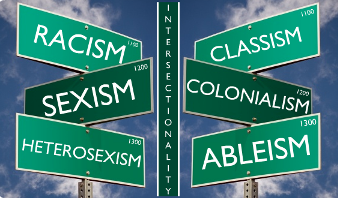
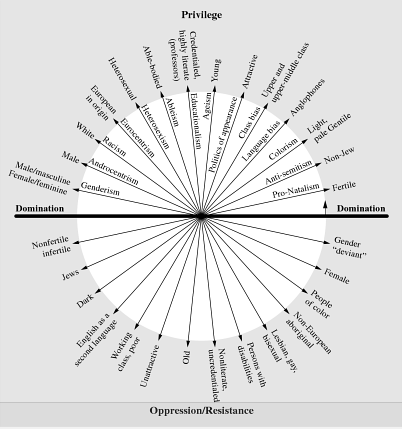
Dream Charter School in East Harlem has one of the most fitting slogans any elementary school has ever seen: "Team Work Makes the Dream Work!" It may sound cheesy, but let's just imagine a world where social activists from all different oppressive backgrounds used Dream's motto to promote intersectionality, producing an intersectionality that is not only talked about, but also acted upon. Where social activist groups who share different experiences of oppression can bound together and realize the source of the oppression is, at it's root, all in the same. It would be the most amazing and radical revolution the world has ever seen. What is preventing this almost blatantly obvious ideology geared towards the track of a new world order, one free of racism and heterosexism, and classism and every other oppressive -ism which stems from the same web of patriarchal cultural imperialism? Are social activists falling into the world's trap of hierarchies, the very traps we ourselves despise?

In Whipping Girl, Julia Serano explains her experience of being excluded from queer, lesbian and gay communities as a trans woman, as well as being looked down upon by feminists and women-only circles. "As a direct result of the exclusion of cross-gender-identified trans people from the 'gay rights' movement, public awareness and acceptance of our identities and issues are about twenty years behind those of lesbian and gays... Because of this exclusion, our cross-gender identities and perspectives are not acknowledged to nearly the same extent as lesbian and gay identities and perspectives."(The Future of Queer/Trans Activism 356). Although Serano blames most of this exclusion on a hypocritical connotation of inferiority placed on femininity, I'd like to focus more on her points about how general transphobia is also the cause for this exclusion, as well as a sort of elitism that hovers over LGBTQ communities who don't consider her "subversive" enough. This focus on hierarchies in general, I believe, will emphasize the lack of intersectionality in social activism of all sorts, as well as why it is so hard as an oppressed group, to accept people that are seemingly more so oppressed.

The transgender woman exclusion from women-only circles and feminist spaces makes me think of many other exclusions in a number of social movements. A few that have popped into my head include a lot of racial minority social activists who often try to distinguish themselves from the "ghetto" or "ratchet" minorities, as well as the gay social activists who feel their political and social progress is hindered by the "flamers." By setting people with the same roots of oppression apart based on social animosities, social activists are creating a hierarchy within oppression, making it so that the most oppressed not only feel marginalized by the norms of society but on top of that, marginalized by the people who share their same struggle. In addition, social activists are creating hierarchies among different types of oppression, forgetting that all of the different types of oppression are caused by the very existence of hierarchies in and of themselves. Even Karl Marx, advocating for the destruction of the social class system, completely failed to include an analysis of how race very obviously intersects. It wasn't because he did not think about it, it was because he didn't want to add more reason for people to critique his already radical notion. He wanted to save face, the same way feminists and LGTBQ communities like to save face when confronted with trans women, whose inclusion would add even more animosity to their social aims by virtue of the very system they want to abolish.

.
Kimberle Crenshaw coined the term intersectionality in 1989 in her essay titled "Demarginalizing the Intersection of Race and Sex: A Black Feminist Critique of Antidiscrimination Doctrine, Feminist Theory, and Antiracist Politics." Although Crenshaw is using the term specifically to speak of minority women's experiences of being faced with multiple systems of oppression but being recognized by only one or none, the same idea can be adopted to Serano's experience of being a transgender woman who is not recognized at all, as well as many other minorities within oppressed groups whose voices are muffled based on internal hierarchies within the oppressed. In page 2 of Censhaw's essay, she offers my favorite intersectionality analogy. She says  "discrimination, like traffic through an intersection, may flow in one direction, and it may flow in another." If there is an accident at the intersection, it is very hard to tell which street the accident came from, as it probably was the result of traffic from multiple cars from different streets colliding. But instead of coming to the aid of the people hurt at this intersection, we wonder first where they came from, and who was responsible. In the time that people are trying to figure out if it was racism or sexism or ableism which caused the accident (when it could very well be all three), the people in need of help are dying. We believe that only the LGBTQ community could aid a transgender person at an intersection, but what if feminists helped as well? And why does the label matter so much? Crenshaw puts it best when she says that this situation is analogous to "a doctor’s decision at the scene of an accident to treat an accident victim only if the injury is recognized by medical insurance."

Social activists everywhere are guilty of this same injustice. We are all guilty of not helping each other out and seeing difference among our neighbors, and being blind to the ways we could all come together for a greater cause. We are guilty of falling into the traps we ourselves are advocating against. We create a hierarchy of oppression as well as create elitism within our "safe spaces" in order to save face politically and socially, in order to appeal to those we claim to be against. We believe that one closely knit set of principles will get us far in our political identity, but doesn't it make sense that if every single mix of privileged and oppressed groups came together, we could flip this world upside down? The feminists, the LGBTQ community, racial minorities, the disabled, the poor and of course all the allies who understand this source of hierarchical oppression and don't see the difference, but rather, the connection between everything that makes our world a brutish place to be. Serano asks for solidarity, and that is exactly what we lack. We need to get ourselves down to this intersection and have a very long talk.

Monday, September 8, 2014

Intersexed: Theory vs. Practice

          In a perfect world, gender norms wouldn't exist at all and much less the concept of your behavior being tied to your genitals. However, living in a society whose very foundation is built on this concept and with sexuality being one of the main driving forces of our human capacity, it is going to be a long time before intersexed individuals are seen as “normal” to the general public. In the article titled Divergence or Disorder, Elizbeth Reis asserts that parents have superficial problems with intersexuality such as fear of other people's opinions and the inability to "reconcile[ing] their child's anatomical condition with thoughts of his or her future sexual activity." ( Page 537). In the world of academia we have the privilege of being able to examine concepts such as gender in depth, outside of the simple biological standpoint, and can come to the conclusion that, hey, it's no big deal if a child is born with both a penis and a vagina. But that leaves me to wonder, how does this go over outside of our liberal bubble? What happens when you decide that your child's sex will not be determined by your doctor or yourself, and out of love and respect let your child develop their own identity.
       According to Healthy Place's Parents of Intersexed children FAQ forum , that is the best way to deal with your child's unique conditions. Many argue that the social anxieties should be irrelevant when its juxtaposed with the possibility and hurting your baby's health in the process of fitting him in a gender box. Some of these anxieties are trivial such as “what should I name them?” with the vast variety of gender neutral names in circuit. Then there are other anxieties which are not so trivial, such as “Will my child grow up confused from things as simple as not knowing which bathroom to use at school?” “Will my child be bullied because of his condition?” “What kinds of factors will go into my child's ultimate decision? Will they choose out of a desperate need to fit in?” “How much harder will their lives be?” “Is love and support from home enough to hold up the weight of society's judgements?” These questions arise from more than just fear of public opinion, they arise from genuine love and the parental desire to give your child the best life they can possibly have.
         When speaking to my homosexual brother once, he told me that he hopes his children don't turn out to be gay, although he would of course love them regardless. He said he wouldn't let his boy wear a skirt if he wanted to. To which I exclaimed, “Why the hell not?” He told me “Deyalyn, you're looking at this from a place of hetero-normative privilege. I'm sure you with your free spirited liberal attitude will let your boy wear a too-too if he asked, but you have to think about what that means for him. Yes he might be happy initially, but what happens when other boys taunt him, and possibly decide to hurt him? Also, do you understand how much more susceptible to ridicule he would be just by having your same skin color? Race is a huge factor that a lot of people forget to incorporate.” A hispanic homosexual who attended Vanderbilt University in the deep south of Tennessee, understanding first-hand the struggle of being ostracized by society for his natural tendency, prays he does not have a gay child because he does not want that child to grow up in a world that condemns him. This has nothing to do with fearing embarrassment and everything to do with genuine love and deep care for his future child. The same could be said about parents who decide to surgically determine their babies' ambiguous sexes.
          Although I would still let my boy wear a too-too if he asked, my brother's view gave me a feeling that I was missing something as an ally. My views come out of a place of privilege, of not really understanding the LGBTQ plight as much as I think I do. The privilege of having a good education, of being naturally attracted to the sex society wants me to be attracted to, of being born with a vagina that feels right to me. There's a whole world out there, probably the greatest chunk in fact, that simply does not and would not ever understand gender fluidity, and might go through violent lengths in order to eradicate the concept, for the sake of their own sanity or even greater, for the sake of their God. Not because they actually understand it and see it as wrong, but simply because they are uneducated and the idea strongly conflicts with everything they've been taught by people they strongly admire. A term “intersexedis not even recognized as a real word in this Open Office word document, and much less one that is recognized by people outside of the high-level education bubble. As much as we want to push against that, how much are we willing to risk? Are we willing to risk our lives, and our children's lives for it?
         One of the main things discussed in many of these forums is how important communication with the child is, never allowing them to feel ashamed or embarrassed and keeping them in the loop at all times. What they don't really explain is what exactly should be said. When should this conversation take place? When the child brings it up, or whenever one deems them to be the appropriate age? How does one explain to a child the origin of a system that is set on women having vaginas and men having penises without making them feel abnormal? What if a parent lacks the appropriate language to use no matter how good their intentions are? One of the forums brought up how crucial it is for a parent to seek help from a gender specialist, but what if they can't afford such a luxury? Surely this is not something that would be covered by healthcare. How much of our tolerance is based on having certain privileges, such as an education and money for specialists and late surgeries?
         So many questions, very little answers. I guess these are things that must be taken by stride. Why assume that your intersexed child is going to be bullied? Maybe it'll be quite the opposite and they'll charm the hell out of their classmates and have lots of friends. So what if you cant afford a gender specialist? There are many helpful forums and safe-haven groups that will give you the language frame you need so that your child is understanding of his condition. Oh and also, just maybe, it's okay to make mistakes. As parents of many “normal” children do. In fact, you'll only be raising a child who is more enlightened and more aware of the diversities of this world. Someone who won't be phased by difference and will treat everyone equally no matter what's in their pants. You'll be raising the kind of person with a perspective thats very rare and very much needed in our society. While there are still other societies that haven't come to terms with things like homosexuality and much less intersexuality, we can't let that hold us back from pushing towards change in our own homes.